Monday, August 16, 2010

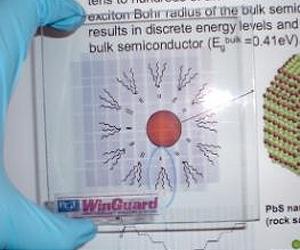
See Through Solar Panels


This is interesting though I would like to see more detail.  The use of organics asks more questions than it answers.  That it can out perform thin film by an order of magnitude implies converting over a much broader spectrum.  So far so good.  Can it be sustained?

This is a new entrant and the claims are at least promising.  Even if the production is nort particularly impressive, it will still have a market merely to make use of a passive resource.  Recall windows must be specially made to begin with, and it will be no trick at all folding this into the supply chain.

Of course, if they can establish sustainable high yield at a low effective cost base, every office building will soon convert and so will everyone else.  Recall how we all use double pane windows these days.


World's First-of-Its-Kind See-Thru Glass SolarWindow Capable Of Generating Electricity

by Staff Writers

Burtonsville MD (SPX) Jul 27, 2010


Researchers Apply Coating to Commercial Glass, Demonstrating Transparency of New Energy's SolarWindow Capable of Generating Electricity, Currently Under Development. Source: New Energy Technologies, Inc.


New Energy Technologies is pleased to announce that researchers developing its proprietary SolarWindow technology have achieved major scientific and technical breakthroughs, allowing the Company to unveil a working prototype of the world's first-ever glass window capable of generating electricity in the upcoming weeks.

Until now, solar panels have remained opaque, with the prospect of creating a see-thru glass window capable of generating electricity limited by the use of metals and various expensive processes which block visibility and prevent light from passing through glass surfaces.

New Energy's ability to generate electricity on see-thru glass is made possible by making use of the world's smallest working organic solar cells, developed by Dr. Xiaomei Jiang at the University of South Florida. Unlike conventional solar systems, New Energy's solar cells generate electricity from both natural and artificial light sources, outperforming today's commercial solar and thin-film technologies by as much as 10-fold.

New Energy's SolarWindow technology is under development for potential application in the estimated 5 million commercial buildings in America (Energy Information Administration) and more than 80 million single detached homes.

"We're always keen to see innovations in our laboratories turn into meaningful commercial products," stated Valerie McDevitt, Assistant Vice President for Research, Division of Patents and Licensing, University of South Florida. "We very much look forward to the commercial development of New Energy's SolarWindow technology, which, if successful, could literally transform the way in which we view the use of solar energy for our homes, offices, and commercial buildings."

The University of South Florida Research Foundation has licensed Dr. Xiaomei Jiang's groundbreaking discovery and important commercial processes and applications to New Energy Solar Corporation, a wholly-owned subsidiary of New Energy Technologies, Inc.

"It's very exciting to see that our ongoing research has led to several significant breakthroughs with transparency and the production of electricity on see-thru glass," explained Mr. Meetesh V. Patel, President and CEO of New Energy Technologies, Inc. "For the first time ever, these advances have allowed us to develop an early-scale working prototype of the technology, which I very much look forward to unveiling in the upcoming weeks."

Ozone Improves Biofuel Production Efficiency


It is of some interest that direct application of ozone degrades the lignin allowing the carbohydrates to be attacked and converted to sugars.  It will not be easy, but it opens another avenue.

Ozone is a bit tricky to produce and expensive and may well limit this method to the laboratory.

However, a process protocol that starts and ends dry is a rather good beginning and leaves a lot of options open for further treatment and no immediate waste stream.

A friend of mine has been testing ozone on ores to some effect, so this is not too surprising.


New Technique Improves Efficiency Of Biofuel Production

by Staff Writers

Raleigh NC (SPX) Jul 06, 2010


Researchers at North Carolina State University have developed a more efficient technique for producing biofuels from woody plants that significantly reduces the waste that results from conventional biofuel production techniques. The technique is a significant step toward creating a commercially viable new source of biofuels.

"This technique makes the process more efficient and less expensive," says Dr. Ratna Sharma-Shivappa, associate professor of biological and agricultural engineering at NC State and co-author of the research. "The technique could open the door to making lignin-rich plant matter a commercially viable feedstock for biofuels, curtailing biofuel's reliance on staple food crops."

Traditionally, to make ethanol, butanol or other biofuels, producers have used corn, beets or other plant matter that is high in starches or simple sugars. However, since those crops are also significant staple foods, biofuels are competing with people for those crops.

However, other forms of biomass - such as switchgrass or inedible corn stalks - can also be used to make biofuels. But these other crops pose their own problem: their energy potential is locked away inside the plant's lignin - the woody, protective material that provides each plant's structural support.
Breaking down that lignin to reach the plant's component carbohydrates is an essential first step toward making biofuels.

At present, researchers exploring how to create biofuels from this so-called "woody" material treat the plant matter with harsh chemicals that break it down into a carbohydrate-rich substance and a liquid waste stream. These carbohydrates are then exposed to enzymes that turn the carbohydrates into sugars that can be fermented to make ethanol or butanol.

This technique often results in a significant portion of the plant's carbohydrates being siphoned off with the liquid waste stream. Researchers must either incorporate additional processes to retrieve those carbohydrates, or lose them altogether.

But now researchers from NC State have developed a new way to free the carbohydrates from the lignin. By exposing the plant matter to gaseous ozone, with very little moisture, they are able to produce a carbohydrate-rich solid with no solid or liquid waste.

"This is more efficient because it degrades the lignin very effectively and there is little or no loss of the plant's carbohydrates," Sharma-Shivappa says. "The solid can then go directly to the enzymes to produce the sugars necessary for biofuel production."

Sharma notes that the process itself is more expensive than using a bath of harsh chemicals to free the carbohydrates, but is ultimately more cost-effective because it makes more efficient use of the plant matter.

The researchers have recently received a grant from the Center for Bioenergy Research and Development to fine-tune the process for use with switchgrass and miscanthus grass. "Our eventual goal is to use this technique for any type of feedstock, to produce any biofuel or biochemical that can use these sugars," Sharma-Shivappa says.

The research, "Effect of ozonolysis on bioconversion of miscanthus to bioethanol," was co-authored by Sharma-Shivappa, NC State Ph.D. student Anushadevi Panneerselvam, Dr. Praveen Kolar, an assistant professor of biological and agricultural engineering at NC State, Dr. Thomas Ranney, a professor of horticultural science at NC State, and Dr. Steve Peretti, an associate professor of chemical and biomolecular engineering at NC State.

The research is partially funded by the Biofuels Center of North Carolina and was presented June 23 at the 2010 Annual International Meeting of the American Society for Agricultural and Biological Engineers in Pittsburgh, PA.

NC State's Department of Biological and Agricultural Engineering is a joint department of the university's College of Engineering and College of Agriculture and Life Sciences.